Module 6 of 6
He anamata rangatira
Sovereign digital futures — building Māori-controlled infrastructure for generations.
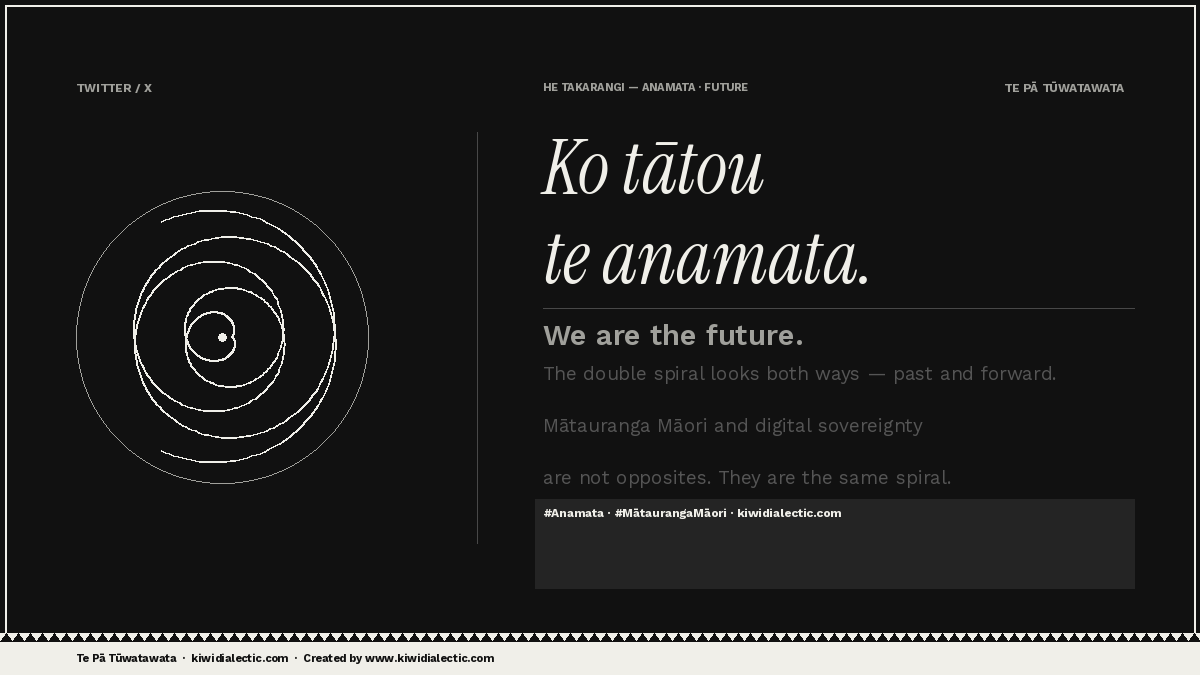
double spiral — balance of light/dark, past/future, sovereignty
This module carries the takarangi — the double spiral. One spiral is the past: the ancestors, the land, the knowledge that has always been here. The other is the future: the anamata rangatira we are building now. They are inseparable. Sovereignty is not a destination; it is a continuous turning.
He kupu whakataki — Introduction
He anamata rangatira — a chiefly, sovereign future. This final module looks forward. Having understood the problem (digital colonialism and data extraction), the legal landscape (tikanga, ture, and Treaty obligations), and the design imperatives (hoahoa tika), we now ask: what does a genuinely sovereign Māori digital future look like, and how do we get there?
The answer is not utopian. It is practical, political, and grounded in the kind of long-term thinking that Māori communities have always applied to questions of survival and flourishing across generations.
What sovereignty means in the digital sphere
- Infrastructure ownership — Māori entities own and operate the servers, networks, and platforms on which Māori digital life runs.
- Governance authority — Māori communities make decisions about how their data is collected, stored, used, and shared.
- Economic control — the economic value generated from Māori digital activity flows to Māori communities, not to external shareholders.
- Cultural integrity — digital systems preserve and strengthen te reo Māori, tikanga, and whakapapa relationships rather than eroding them.
- Intergenerational accountability — decisions about digital infrastructure are made with the same long-term perspective applied to land and environmental stewardship.
Building blocks: what already exists
- Te Mana Raraunga — the Māori Data Sovereignty Network, which has developed foundational policy frameworks.
- Kāhui Raraunga — working on Māori data governance models and practical implementation frameworks.
- Te Hiku Media — demonstrated that community-led development of te reo Māori AI is possible, and that communities can retain ownership of their own language technology.
- Iwi investment entities — post-settlement governance entities now manage significant capital that could be directed toward digital infrastructure investment.
- Te Pā Tūwatawata — the anchor initiative explored throughout this course, bringing together these threads into a concrete infrastructure vision.
A closing provocation
The history of colonialism is a history of being told that what Māori want is impossible, unrealistic, or too expensive. That the land could not remain in collective ownership. That te reo Māori could not survive. That iwi could not manage their own economic development.
All of these predictions were wrong. He anamata rangatira — a sovereign future — has always been possible. The question is always the same: who has the will to build it, and who will stand in the way.
Key concepts
- Anamata rangatira A chiefly, self-determined future
- Te Hiku Media A model for community-owned Indigenous language AI
- Digital sovereignty The collective right of communities to control their own digital infrastructure and data
- Intergenerational accountability Making decisions about infrastructure with a seven-generation perspective
Kua oti — Course complete
You have completed all six modules of Te Pā Tūwatawata. Tino pai — well done.
Back to course overview Follow The Kiwi DialecticPātai — Discussion questions
- What lessons does Te Hiku Media's approach to te reo Māori AI hold for other Indigenous communities worldwide?
- What political changes would be needed at the New Zealand government level to make Māori digital sovereignty achievable within a generation?
- How should iwi post-settlement governance entities prioritise digital infrastructure investment relative to other economic priorities?
- Having completed this course: what is the single most important action that you, in your own context, could take to support Māori data sovereignty?